Completed in May 2024, Griffin Green is a $12 million affordable housing project that showcases what can be achieved when deep collaboration between a local council and a local community housing provider receives substantial state and/or federal support. The homes, owned and managed by Argyle Housing, are available for rent for local key workers earning low to moderate incomes.
With monthly rental listings in Griffith dropping to just 50 in 2021 (equivalent to a vacancy rate less than one per cent), the additional 20 new affordable rental townhouses are a significant contribution to local supply. The project also delivered 35 vacant lots for affordable homes to become available for purchase, and the revitalisation of Dave Taylor Park into Griffin Green Youth and Community Park. Deep, and often immeasurable, transformations are also taking place in the lives of the residents and the fabric of the wider local community.
The $12 million project costs were split three ways between the Australian Government through the Building Better Regions Fund ($6 million), Argyle Housing ($3 million) and Griffth City Council ($3 million).
Key insight: Griffith’s rental market has been notoriously tight in the years both leading up to and after the pandemic.
Background
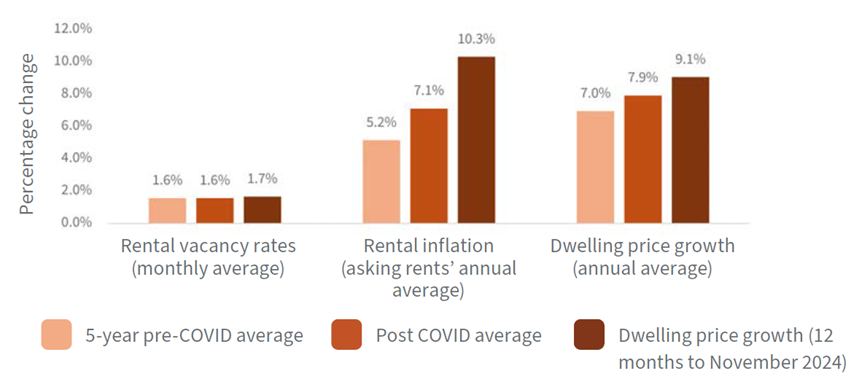
Monthly rental vacancy rates in the five years prior to the pandemic averaged just 1.6 per cent and tight conditions continue to persist after the pandemic. These conditions have improved in the last 12 months; the average vacancy rate lifting to 1.7 per cent in the 12 months to November 2024.
The tight rental supply has been accompanied by an acceleration in the growth of asking rents.
Griffith City Council, in its Background Paper to its 2019 Housing Strategy, specifically identified the biggest issue, in terms of housing affordability as ‘the large and increasing number of very low income renting households, often in severe housing stress, and the general inability of the market to provide for such households’.
Griffith housing market conditions
Griffth housing market conditions (purchase and rental)
Source: CoreLogic, RAI
Strategic planning
Key insight: Strategic planning is foundational. The Council’s established housing strategy – its local evidence and its focus and explicit recommendations on more social and affordable housing – is where the Griffin Green project finds its ultimate genesis.
In and around persistently tight local housing conditions, the Griffith City Council commissioned the Griffith Housing Strategy 2019. The Strategy, together with the accompanying Affordable Housing Background Paper, quantified the local demand for affordable housing and set out specific actions that the council could take to meet this demand. These actions ranged from weak through to strong interventions. The Griffin Green Project arose from the strong end of those recommended interventions, including:
- Use public resources in affordable housing public private partnerships, e.g. through partnerships on council or other land via land audits; expressions of interest to create affordable housing on public land.
- Enter into longer term development and/or management partnerships with preferred community housing provider.
Collaboration – between Griffith City Council and Argyle Housing
Key insight: Collaboration between the local council and the local community housing provider was crucial to overcoming typical barriers to affordable housing supply and realising deep community transformation. Federal funding was significant and essential.
Affordable and social housing developments are generally not viable without subsidy. The collaboration between Griffith City Council and Argyle Housing mobilised existing, available resources and expertise and was a strong candidate for financial support from an existing Commonwealth program, the Building Better Regions Fund.
The specific contributions:
- Argyle Housing – As the local Community Housing Provider, its expertise spans the full range of activities in and around social and affordable housing; from fundraising and financing, to actual property development, through to ultimate management of the properties and tenancies. Argyle Housing accessed a $1.48m state government grant to fund the development of a new Dave Taylor community park and basketball court as part of the broader place-making vision to revitalise the area and transform and improve the local community, as well as a new Community Hub that will bring vital support services to the local community. Argyle Housing’s financial contribution to the project was $4.4 million.
- Griffith City Council – The Council identified and purchased underutilised, state-owned land. The Council invested in the enabling civil works, which included constructing internal connecting roads, and facilitating connections to water, sewerage, electricity, and nbn services. The Council also supported land remediation of the unused existing Dave Taylor Park and the land was ultimately gifted to Argyle Housing for the redevelopment of the park and basketball court. The overall value of the Council’s contributions is to the tune of $3.9 million. The Council will continue its involvement in Griffin Green, by maintaining the new basketball court and the wider, revitalised Dave Taylor Park.
- Australian Government – The project successfully bid for funding from the Building Better Regions Fund, receiving $6 million.
Argyle Housing
Argyle Housing is a community housing provider operating in south-west New South Wales, predominantly in the regions, but also in the south-west of Sydney. It manages 2,700 properties with 4,500 clients and has further projects in development.
Argyle Housing’s approach is one based on genuine community consultation and placemaking programs, which enhance neighbourhood interaction and foster a deeper connection to place.
The placemaking for Griffin Green is deeply informed by consultation and collaboration with the First Nations people of the local land, the Wiradjuri people. The overall Griffin Green development includes a basketball court artwork installation. This artwork was designed by local Aboriginal artist Karissa Undy and represents connection to community and country. It has since become an important gathering point for local children, residents and visitors alike. The revitalised greenspaces of the development include a yarning circle and Indigenous medicinal gardens. Plants and herb information is labelled with a plaque in both English and Wiradjuri names. Argyle Housing has and will continue to collaborate with the local Aboriginal Land Council – to name the development’s Community Hub building, and on further activities upon its completion.
Another collaboration behind the placemaking of the overall Griffin Green development has been with the Botanic Gardens of Sydney. Specifically, its Community Greening Program was a key force behind the overall green space and gardens of the revitalised Dave Taylor Park.
Project governance
Key insight: While collaboration is crucial, potential conflicts need to be addressed.
Clear roles were established between the Council and Argyle Housing and formalised through a Project Control Group. This group ensured close coordination and joint oversight. The formal structure also ensured a clear separation within the Council’s own roles and responsibilities – separating and preventing conflicts between the roles as both the consenting authority and the project proponent.
Additional planning elements – statutory planning
Key insight: In this instance, the local consent authority, Griffith City Council, was able to conduct the various consent processes in a smooth and timely manner. The main state-based development pathway designed to streamline and expedite these processes was initially sought after by the project proponents, but ultimately not applied to this project.
A key tool for streamlining and expediting development approval processes in New South Wales is the Regionally Significant Development pathway. As a community project with a $12 million budget, Griffin Green appears an ideal candidate for this status and the associated streamlined and expedited development pathway. The project proponents sought this status but received little engagement from the relevant planning panel. Ultimately this status was not consequential for the project – the proponents found the regular local processes conducted by the local authorities to be smooth and reasonably timely. However, the situation suggests that the Regionally Significant Development pathway may not be working as intended.
Find out more in the full “Answering the Call for Regional Housing” Report.
Acknowledgment of Funding
The research presented in this report was funded by the RAI’s Intergovernmental Shared Inquiry Program. The program delivers an annual public interest research agenda focusing on topics of strategic importance to regional Australia through a partnership with federal, state and territory governments.
The RAI acknowledges our funding partners: Australian Government Department of Infrastructure, Transport, Regional Development, Communications, Sports and the Arts; New South Wales Government Department of Primary Industries and Regional Development; Queensland Government Department of Natural Resources, Mines, Manufacturing, Regional and Rural Development; South Australian Government Department of Primary Industries and Regions; Victorian Government Department of Jobs, Skills, Industries and Regions; and Western Australian Government Department of Primary Industries and Regional Development.
The views expressed in this report are those of the Regional Australia Institute and are not necessarily those of the Australian Government or the Department.